Picture the end of a normal group time.
You have been sitting on the rug doing maths. There are counters, linking cubes or number cards still scattered between the children. Everyone is ready to move onto the next part of the day.
Before you say “everyone up”, try something slightly different.
Ask the children to see if they can stand up from the rug without using their hands.
Then watch.
You will probably see lots of different strategies
One child may move smoothly onto one knee, bring a foot forward and stand.
Another might rock forward a few times before getting enough momentum.
Someone else may immediately put both hands on the floor.
Another child might push their hands into their thighs, grab the nearest chair, or roll onto hands and knees before standing.
None of these observations on their own mean that something is wrong.
What interests me is how much effort the movement seems to require, and whether the same child consistently finds everyday transitions physically difficult.
Getting up from the floor is a surprisingly complex movement
As an Exercise Physiologist, this is exactly the kind of functional movement I love watching.
To get from the floor to standing, the child has to organise their body against gravity.
They need enough lower limb strength to lift their body weight. Their trunk has to stay controlled as their centre of mass moves. They need to shift weight from one side to the other, organise their feet underneath them and maintain balance as their body rises.
There is also a motor planning component. The child needs a movement strategy that gets them from where they are now to standing.
Clinical sit to stand testing is used in some paediatric populations as a measure of functional lower limb strength and balance. In the classroom, I am not suggesting teachers administer a clinical test. I am suggesting we become better observers of the everyday movements already happening around us.
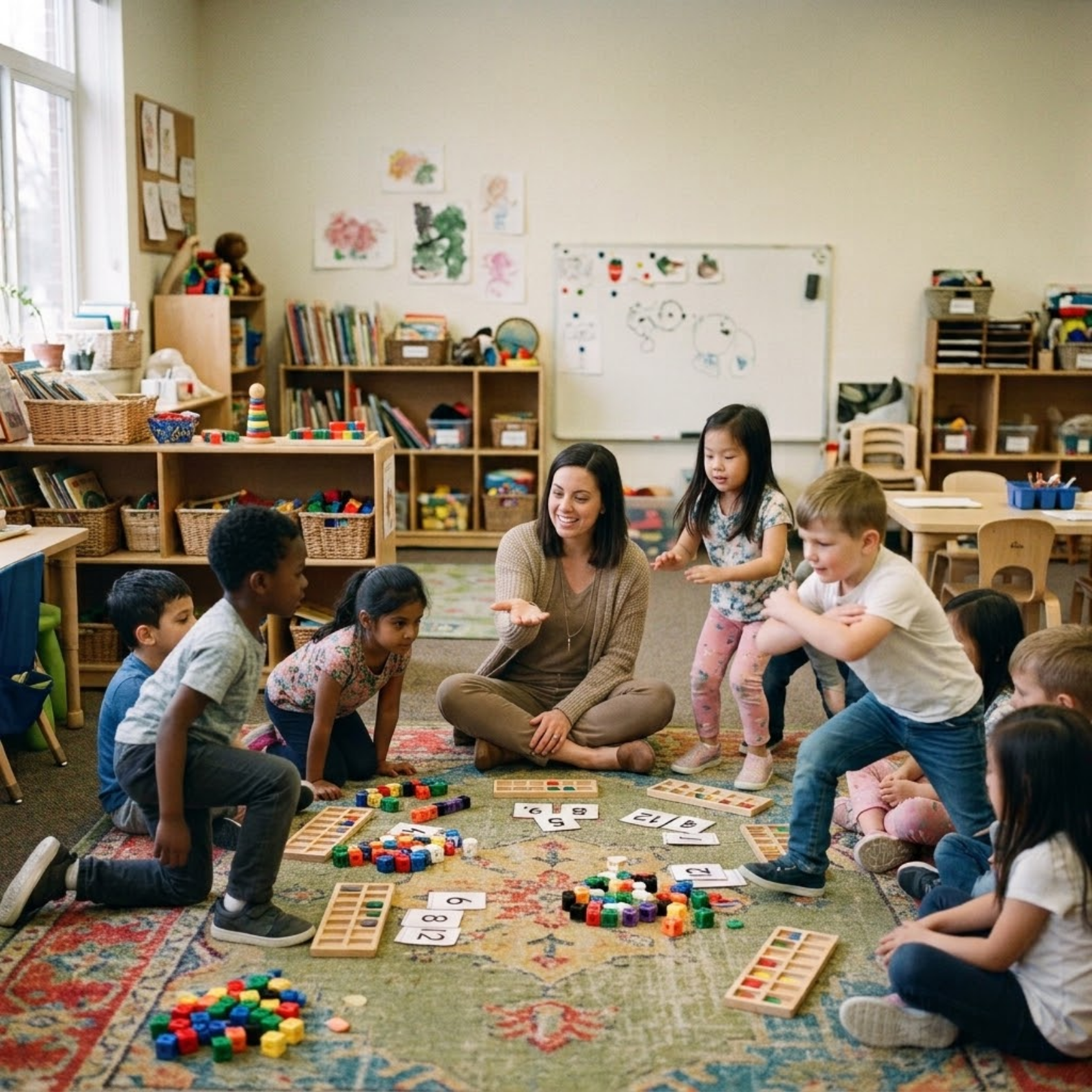
The end of group time gives educators a natural opportunity to notice how children organise strength, balance and movement without setting up a separate exercise session.
The hands are not the problem
I do not want teachers walking around telling children they are no longer allowed to use their hands to stand up.
Hands are a perfectly useful movement strategy.
What I want you to notice is whether a child appears to rely heavily on additional support every single time.
Can they experiment with another strategy when the task is made playful?
Can they move through kneeling?
Can they bring one foot forward?
Can they control the movement slowly, or do they need momentum to get themselves upright?
It is the pattern over time that becomes interesting.
Try this after group time
The no hands stand up challenge
At the end of a normal floor activity, stay seated with the children and say something like:
“Before we move on, see if you can work out a way to stand up without putting your hands on the floor.”
Let them experiment.
Some children will find a way immediately. Others might copy a friend. Some may still need their hands, and that is okay.
You can demonstrate moving from sitting into kneeling, then bringing one foot forward into half kneeling before standing.
Keep it light and curious rather than turning it into a competition.
Half kneeling is worth practising too
Half kneeling is the position where one knee is on the floor and the opposite foot is planted in front.
I like it because it reduces the size of the base of support and asks the child to organise their trunk and hips while the two legs are doing different jobs.
You can bring this into ordinary classroom activities.
Put puzzle pieces on a low table. Have children place maths cards on a board from half kneeling. Let them move through half kneeling when they collect something from the floor.
We do not need to call it strengthening.
We simply need to give children more reasons to use the movement.
What else would make me curious?
I would look at the bigger pattern if the child also:
- frequently pulls on furniture or adults to get themselves up
- uses their hands heavily on their thighs when rising
- avoids getting down onto the floor in the first place
- struggles with stairs, squatting, climbing or getting onto low equipment
- seems to tire more quickly than other children during walking or active play
- has difficulty balancing when one foot is positioned differently from the other
- regularly chooses furniture or another person for additional support
Again, none of these things gives an educator a diagnosis.
They give us observations.
And good observations can be incredibly useful when educators, families and health professionals are trying to understand why everyday participation feels harder for a particular child.
Strength does not have to look like exercise
This is probably the biggest Exercise Physiology message I want to bring into early childhood and primary classrooms.
Children do not need a row of traditional strengthening exercises to build physical capacity.
Getting down to the floor and coming back up is strengthening.
Squatting to collect blocks is strengthening.
Climbing outdoors is strengthening.
Carrying a basket of books is strengthening.
Moving through kneeling to reach something is strengthening.
The school day already contains dozens of movement opportunities. We just need to start seeing them.
Try watching tomorrow
At your next group time, do not change anything at first.
Just watch how the children stand.
Who moves smoothly?
Who uses momentum?
Who automatically reaches for their hands?
Who looks for furniture?
Who chooses a completely different strategy?
Then instead of correcting the child, think about how you can give the whole group more opportunities to get down, get up, kneel, squat, climb and move through different levels during the day.