You probably know the child I mean.
They start drawing at the table and within a few minutes their chest is resting against the edge. Their head drops into one hand. They lean across the person beside them. Or they seem to wrap their whole body around the chair just to stay there.
Sometimes they lean on you when they are standing too.
Then you head outside for a walk and they are the first child asking when they can sit down.
It can be easy to read all of that as poor posture, tiredness, distraction or even a lack of effort.
But sometimes I think we need to ask a different question.
Posture is an active job
Sitting still is not actually passive.
The trunk has to keep the body upright while the shoulders remain stable enough for the hands to draw, write, cut, build and manipulate small objects.
The child also has to keep adjusting their position as they reach, turn, look up at the teacher and come back to their work.
If maintaining that position takes a lot of effort, leaning can become a very sensible strategy.
The table gives the body another point of support. The hand under the head reduces the amount of work needed to hold the head upright. Leaning against furniture can make standing feel easier.
That does not mean every child who leans has poor core strength. Children lean for all sorts of reasons.
It simply means that when I see the same pattern repeatedly, I become curious about the physical demands underneath it.
What I would quietly notice
Look for patterns rather than one sitting position
- Does the child lean during most table activities or only when they are tired?
- Do they regularly rest their head in their hand while drawing or writing?
- Do they prop against furniture when standing?
- Do they avoid longer walks, climbing or active outdoor play?
- Do they change position constantly during floor time?
- Do they tire quickly when activities require their shoulders to support their body?
- Does their movement look noticeably more effortful than that of other children of a similar age?
One observation does not tell us very much.
A repeated pattern across different parts of the day gives us much more useful information.
Why I still use tummy time with older children
Tummy time tends to be talked about as something for babies.
But prone activities can still be incredibly useful once children reach kindergarten and school.
When a child lies on their tummy and props through their forearms, the neck, shoulders and trunk have to work while the hands complete another task.
That is why I like turning the position into something meaningful rather than asking children to simply hold an exercise.
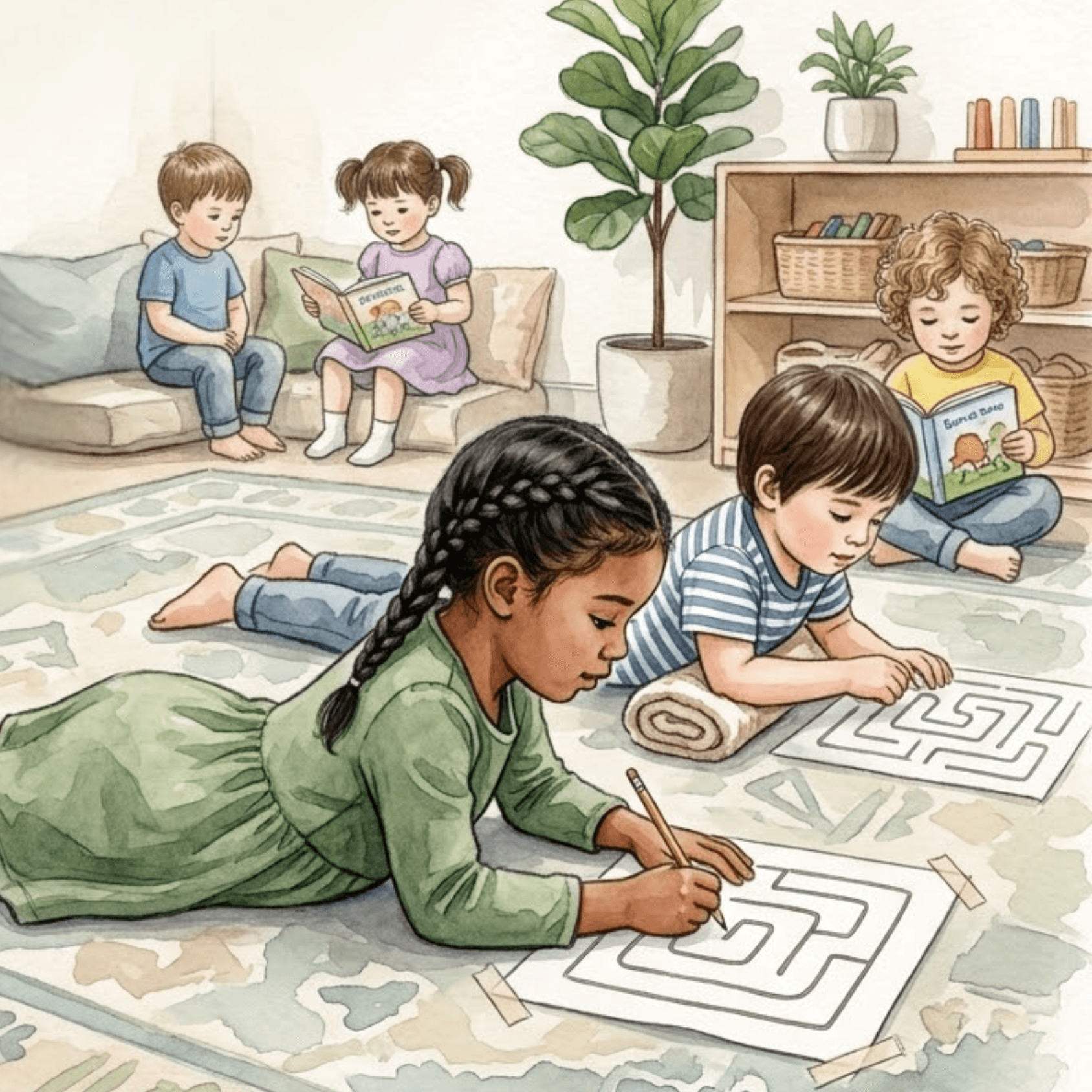
A maze, drawing task or puzzle can keep the hands busy while the upper body quietly does the physical work.
Try a tummy time maze
Place a simple maze, drawing sheet or tracing activity on the floor.
Ask children to lie on their tummy and prop themselves through their forearms while they work.
Keep the activity short initially. A child who is working very hard in this position may only manage a small amount before their chest drops to the floor or their head comes down.
That is not a reason to keep telling them to get back up.
It is information.
Make the activity easier before making it longer
This is one of the biggest things I want educators to remember.
If a child is struggling physically, more repetitions are not always the best starting point.
Give them enough support to experience success.
You might place a small rolled towel under the chest. Use a large marker that is easier to control. Put the maze closer to the child. Choose something they can finish quickly.
Another child may be ready to prop higher through their hands or reach slightly further away for puzzle pieces.
The same activity can look different for different bodies.
Do not turn posture into another behaviour battle
I am not a fan of repeatedly telling children to “sit up straight”.
If a child can comfortably maintain a more upright position, a reminder may occasionally help.
But if the posture is difficult because the physical capacity underneath it is still developing, reminders alone do not build that capacity.
Build movement into things you are already doing
This does not need to become another program teachers have to fit into an already full day.
Drawing can happen on the tummy.
A puzzle can be completed in tall kneeling.
Maths materials can be placed on the floor so children move between sitting, kneeling and standing.
Children can carry books, push chairs in, crawl through a play setup, climb outdoors, reach across the body and spend more time moving between different positions.
These ordinary movement opportunities add up.
When I would look more closely
Leaning on a table by itself is not something I would diagnose.
I would become more interested when it sits alongside other patterns.
Perhaps the child also struggles to get up from the floor, avoids physical play, tires unusually quickly, seems uncomfortable, loses skills they previously had, or is finding everyday participation increasingly difficult.
That is when documenting what you are seeing and having a conversation with the family can be helpful.