There is something beautifully simple about watching children jump.
A line on the floor becomes a river.
A chalk mark becomes somewhere they have to land.
A teacher says “jump and freeze” and suddenly the whole class is laughing while their legs, trunk and balance systems are doing an enormous amount of work.
As an Exercise Physiologist, I see all of that.
But these days I see something else as well.
I also work with older adults.
I spend time thinking about the strength someone needs to get up from a chair, climb a step, recover their balance, walk confidently through their home and keep doing the everyday things that matter to them.
Working at both ends of the lifespan has made me even more passionate about protecting movement in childhood.
I think we sometimes underestimate what a jump asks the body to do
A jump looks simple because children make it look playful.
Physiologically, there is quite a lot going on.
The child bends through the hips, knees and ankles, generates force through the legs, moves their body away from the ground and then has to control that same body as it returns.
A two foot jump also asks the two sides of the body to work together.
Then comes the part I particularly like watching: the landing.
Landing asks the body to absorb force while staying controlled. The ankles, knees, hips and trunk all have a job to do while the child regains their balance.
The muscles around the hips, knees and ankles help produce the force needed to lift the body away from the floor.
During a two foot jump, the right and left sides need to work together to produce and control the movement.
The trunk helps organise the body while it accelerates, leaves the floor and returns to the ground.
The child needs to control their centre of mass and regain stability after moving through space.
This is why screens worry me as an Exercise Physiologist
I want to say this carefully because I am not interested in frightening parents or making teachers feel guilty about screens.
Screens are part of modern childhood.
Children use technology to learn, communicate, create and relax. Gaming can be fun. It can be social. And sometimes families simply need a quiet afternoon.
My concern is not that looking at a screen somehow makes a child's legs weak.
My concern is what can happen when highly engaging sedentary activities become much easier to fit into a child's day than jumping, running, climbing, squatting and playing.
The screen itself is not doing something to the leg muscles
The issue I think about is opportunity.
Muscles become capable because we give them jobs to do.
Legs get opportunities to produce force when children run, climb, jump, squat, pedal, push against the ground and carry their own body weight through play.
If more and more recreation happens sitting down, there are simply fewer opportunities for those physical experiences unless we deliberately protect time for them.
Australian physical activity recommendations reflect this.
For children and young people aged 5 to 17, the recommendation is at least 60 minutes of moderate to vigorous physical activity each day, with vigorous and muscle and bone strengthening activities included on at least three days each week.
The Australian guidelines also recommend limiting sedentary recreational screen time to no more than two hours per day for this age group.
I do not see those recommendations as another rule for exhausted families to fail at.
I see them as a reminder that growing bodies need opportunities to physically work.
Why leg strength in childhood matters to me so much
We cannot look at a seven year old and predict exactly how strong they will be at 70.
Human health does not work that neatly.
What we do know is that muscular strength shows some tracking across the life course.
Australian longitudinal research following people from childhood into adulthood has found that childhood physical activity, physical fitness and positive attitudes toward being active were associated with more favourable muscular strength patterns later in life.
That matters to me.
Not because childhood jumping is an insurance policy against weakness in old age.
It matters because childhood is one of the places where children begin discovering whether movement feels familiar, achievable and enjoyable.
If being active feels difficult from the beginning, children may have fewer reasons to seek it out.
If we can help movement feel successful, playful and normal, we have given them something worth carrying forward.
The other arm of my work
I see the other end of this story too
Alongside Play Move Improve, I work with older adults through Senior Home Connection.
At that stage of life I am often thinking about very practical questions.
Does this person have enough leg strength to rise from their chair?
Can they manage a step?
Can they recover their balance when something unexpected happens?
Can they keep walking, gardening, visiting family and doing the ordinary things that help life still feel like their own?
Strength and balance matter at six.
They matter at 46.
And they matter enormously at 86.
My work looks different at each end of the lifespan, but the underlying belief is the same: movement supports participation.
Visit Senior Home ConnectionI am not asking teachers to run fitness classes
This message is not about adding another item to an already crowded curriculum.
Children can strengthen their legs in the middle of ordinary play.
Jump across a pretend river.
Squat to collect the blocks.
Run to the next chalk marker.
Climb the playground steps.
Jump off a low safe surface and practise landing softly.
Stand up from the floor.
Carry equipment.
Play a game where the body has to move.
None of that needs to look like a gym session.
Jumping gives us so many variations
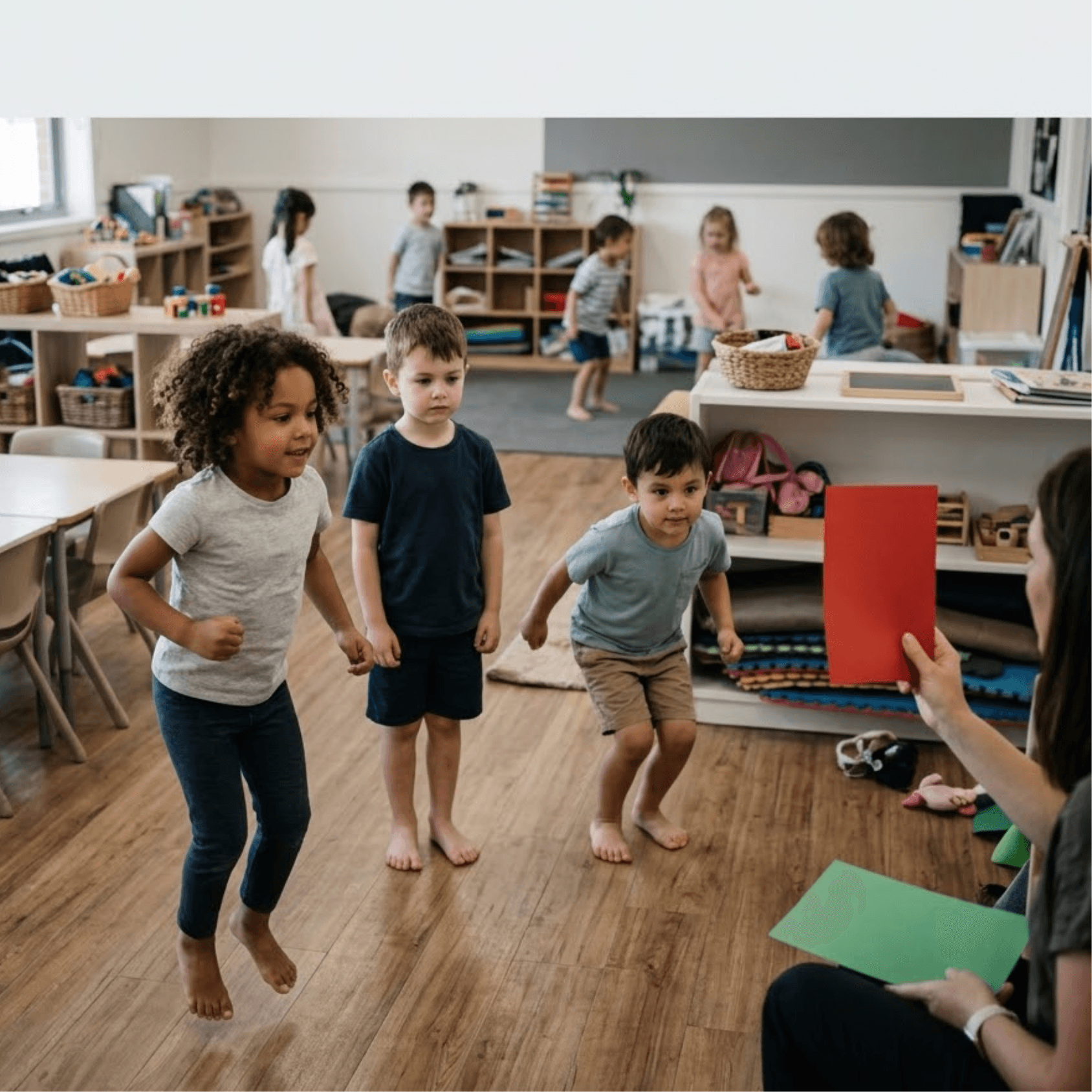
A simple jump and freeze game can ask children to generate force, coordinate both legs and regain their balance when they land.
Try jump and freeze
Give every child enough safe space around them.
Ask them to jump once and then freeze their landing.
See if they can land quietly.
Then try two jumps and freeze.
Jump forwards and freeze.
Jump backwards and freeze.
Jump slightly to one side and regain balance.
For children who are still learning to jump, make the target smaller and let them practise bending their knees, rising onto their toes or stepping over a line before expecting a full jump.
The goal is not height or competition. I want controlled, confident movement.
The landing tells me a lot
When I watch jumping, I often pay as much attention to the landing as the take off.
Does the child land and regain control?
Do their knees bend to help absorb the landing?
Do they immediately need another step to stop themselves falling?
Are both feet working together?
Does the child look confident enough to try again?
These are observations, not a diagnosis.
But they help us understand the physical challenge the child is experiencing.
See the movement ideas
Simple jumping activities for children
Here is one of my short movement videos showing jumping ideas you can use to get children moving without needing specialist equipment.
And what about the child who cannot jump yet?
This is where compassion matters.
A child who avoids jumping may not be refusing movement.
Jumping may genuinely be hard.
They may still be developing the leg strength, balance, coordination or confidence needed to leave the ground and land safely.
If we turn every movement activity into a race, that child quickly learns something we never intended to teach them.
They learn that movement is where everyone else succeeds faster.
Let them step first.
Hold a stable support if they need it.
Give them a tiny line to cross rather than a huge distance.
Celebrate control rather than who jumped the furthest.
Then build from there.
I want us to protect active childhoods
Technology is not disappearing.
Nor do I think it needs to.
But movement should not quietly disappear around it.
Children need places where running is allowed.
Time when they can climb.
Adults who still invite them to jump.
Classrooms where standing and moving are sometimes part of learning.
Playgrounds where their bodies get to solve physical problems.
Families who can choose a walk, a bike ride or ten minutes kicking a ball without feeling that it has to become organised sport.
I am not worried about whether every child becomes athletic.
I am worried about whether we are giving growing bodies enough opportunity to become strong.
This is the bigger picture for me
When I encourage a six year old to jump, I am thinking about coordination, leg strength and balance today.
But I am also protecting the idea that using your body is a normal part of life.
That is a relationship with movement I hope children can keep long after they leave our classrooms.
A note about screens and leg strength
I want to be very clear about the science here.
I am not claiming that recreational screen use directly causes weak leg muscles.
My Exercise Physiology concern is that long periods of sedentary recreation can reduce the time available for activities that challenge growing muscles and bones.
Research following people across the lifespan also suggests that physical activity, fitness and muscular strength during childhood are relevant to later strength trajectories.
That is why I would rather talk about protecting opportunities for movement than blaming technology.
Evidence behind this article
I have kept the claims in this article deliberately careful. The following sources informed the physical activity and lifespan discussion:
- Australian Government physical activity and sedentary behaviour recommendations for children and young people
- Childhood factors associated with muscular strength trajectories between childhood and mid-adulthood
- Muscular strength across the life course in an Australian cohort
- Longitudinal changes in device measured physical activity from childhood into adulthood
- Physical activity through adolescence and development of hip strength