When I talk to educators about core strength, I sometimes worry they picture children doing crunches on a mat.
That is not what I am interested in.
I am interested in the child who is trying to draw while their whole body slowly collapses onto the table.
The child who leans against an adult while standing.
The child who wants to lie down during floor time.
The child who struggles to stay steady while one arm reaches across the body.
Or the child who seems to use far more effort than everyone else just to hold themselves upright.
Think about what the trunk has to do all day
The trunk is the stable centre that the arms and legs move from.
When children write, reach, throw, climb, crawl, balance or get up from the floor, the muscles around the trunk are continuously adjusting.
Sometimes they need to stop the body from falling sideways.
Sometimes they need to control rotation.
Sometimes they need to keep the shoulders and pelvis organised while the arms and legs are moving in completely different directions.
The trunk needs enough endurance to support the shoulders while the hands draw, cut, write and manipulate objects.
Children need trunk control to rotate, reach, change sitting position and move between sitting, kneeling and standing.
Climbing, crawling, throwing and balancing all ask the trunk to stabilise while the limbs create movement.
Getting up from the floor and changing levels requires the trunk to work with the hips and legs against gravity.
What might low postural endurance look like?
I would never diagnose weak core muscles because a child slouched once after lunch.
I am looking for repeated patterns.
You might notice a child who regularly:
- rests their chest heavily against the table
- supports their head with one hand during drawing or writing
- leans against furniture or other people when standing
- changes position constantly during floor time
- avoids tummy time style play
- tires quickly during longer walks or active play
- finds crawling or kneeling physically demanding
- uses a very wide base of support whenever possible
- finds reaching away from their body difficult
There are many possible reasons for these behaviours.
But if I keep seeing the same physical strategies across the day, postural strength and endurance are part of the bigger movement picture I want to consider.
This is why I still love tummy time for older children
We talk about tummy time constantly with babies, then somehow stop talking about prone movement once children get older.
But lying on the tummy can still give the upper body a really useful job.
When children prop through their forearms, they need to lift and control the head and upper trunk while the shoulders support part of their body weight.
Give the hands something interesting to do and suddenly it does not feel like an exercise.
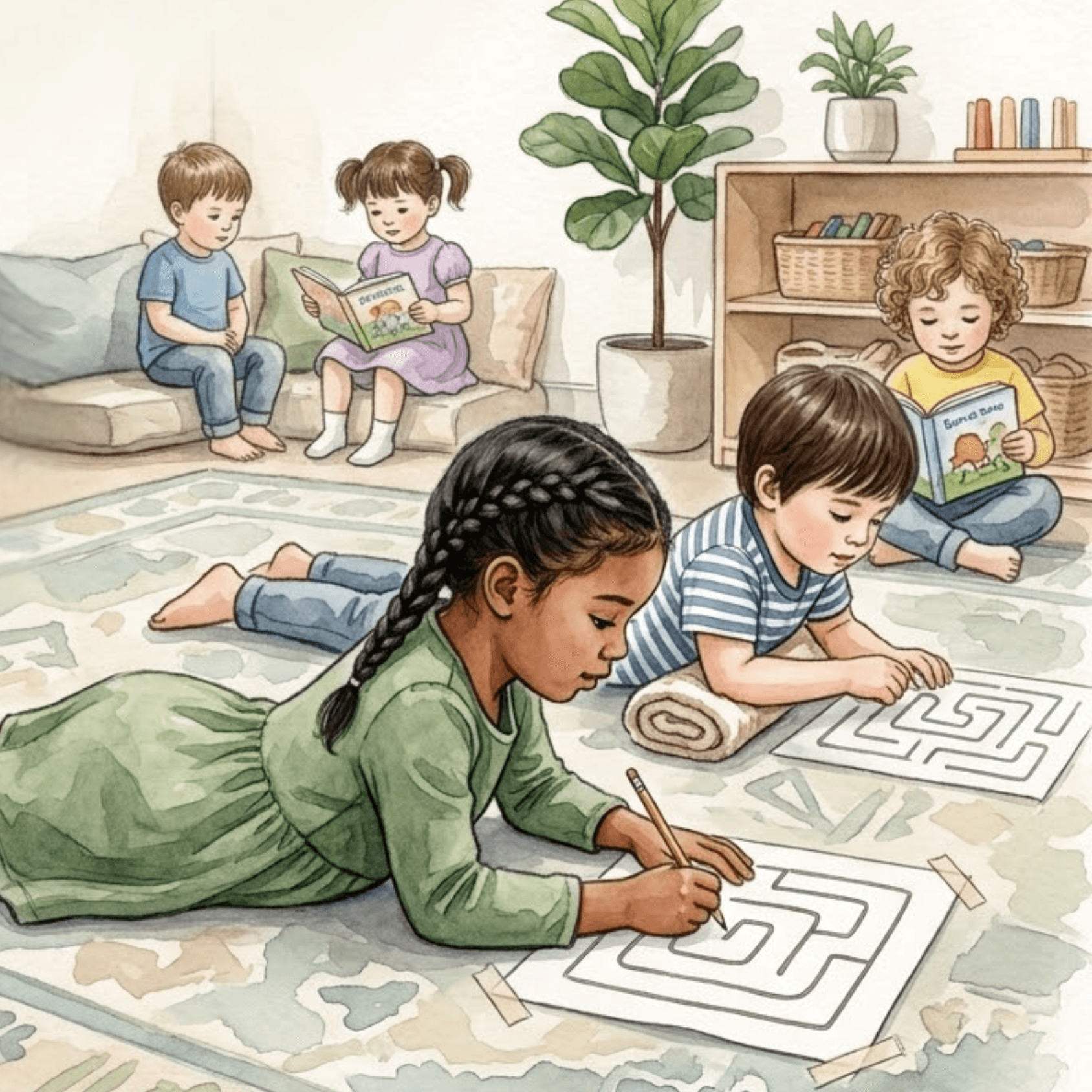
A maze or drawing activity keeps the child engaged while the shoulders, neck and trunk quietly do the physical work.
Try tummy time drawing
Put a maze, drawing activity or puzzle on the floor.
Let children lie on their tummy and prop through their forearms while they work.
If the child tires quickly, make the activity easier before you make it longer.
Try a small rolled towel under the chest, a larger marker, a shorter maze or an activity they can finish quickly.
Core strength also needs movement, not just holding
Children need to be able to stabilise while something else moves.
That is where reaching, cross body movement and changing positions become valuable.
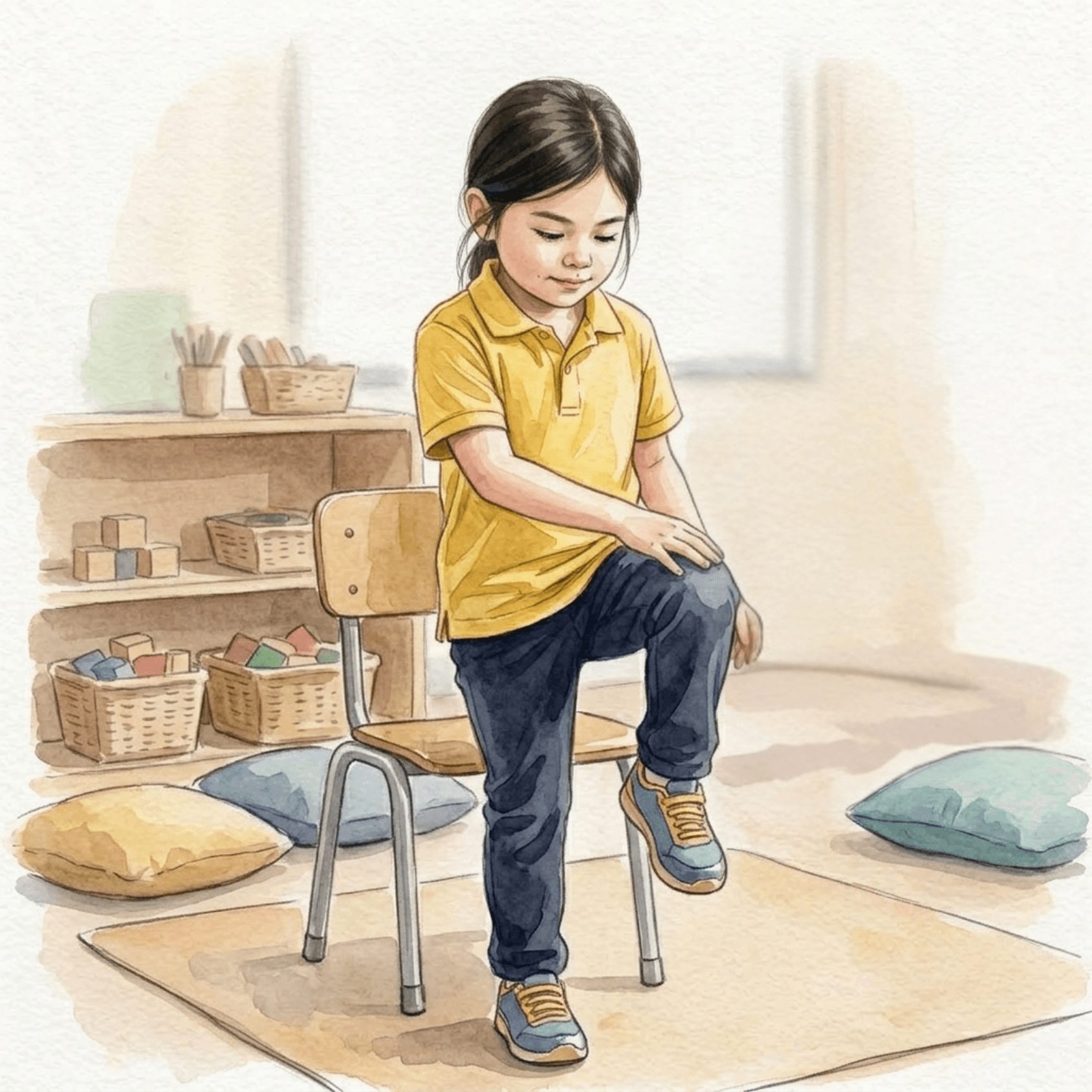
Giving a child external support can allow them to practise trunk control and lower limb movement without balance becoming the biggest challenge.
Watch what happens when one limb moves
This is something I find really useful to observe.
Can the child lift one knee without the whole trunk collapsing?
Can they reach across their body without needing to move their entire body with the arm?
Can they keep their trunk relatively steady while one hand leaves the desk or chair?
Useful core control is often easiest to see when we make the body manage a small amount of movement away from its centre.
Getting up from the floor is core work too
This is why I keep coming back to everyday functional movements.
Getting from the rug to standing asks the trunk, hips and legs to work together against gravity.
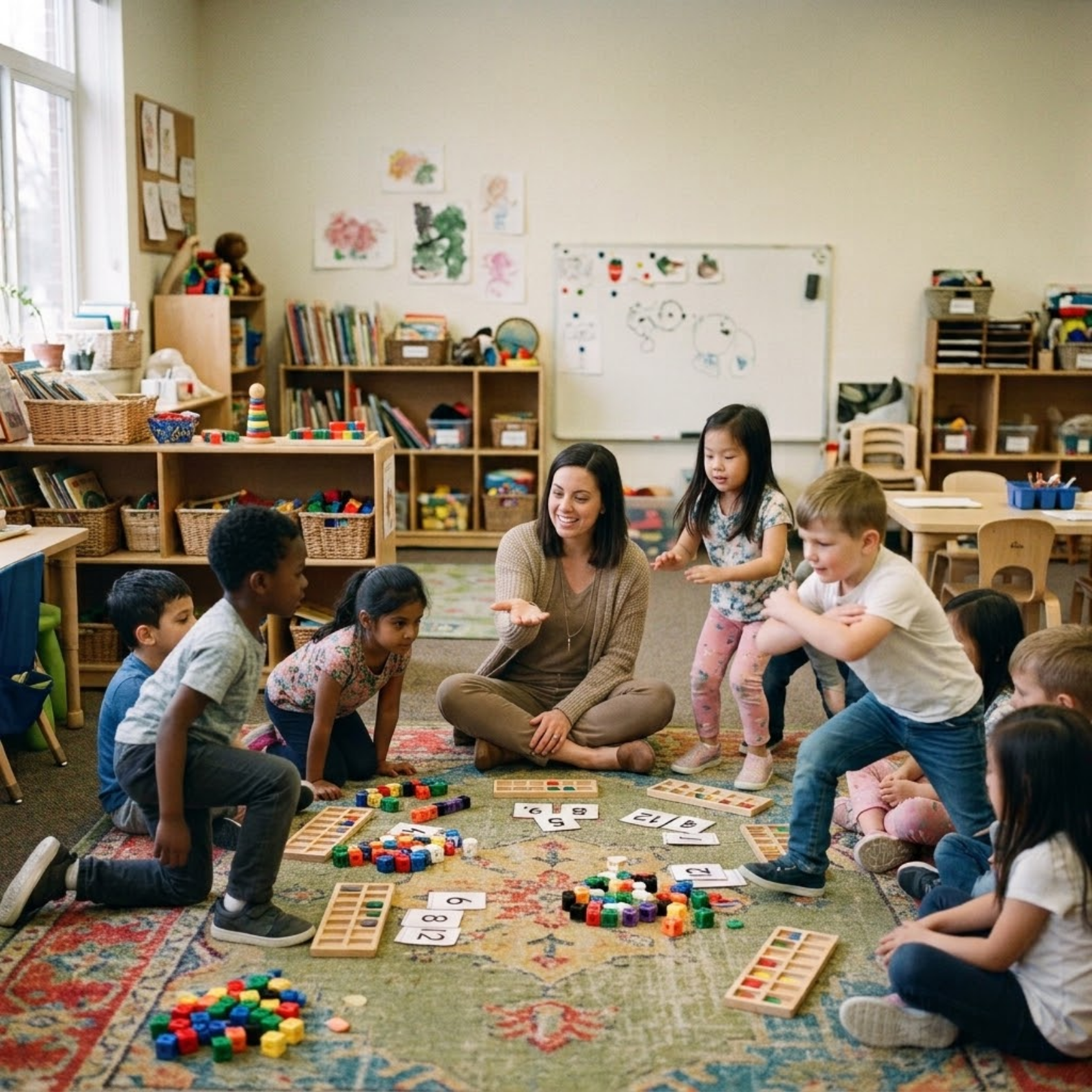
Everyday floor transitions give children repeated opportunities to use trunk control, weight shifting and lower limb strength.
You do not need to set up a core strengthening station every morning.
Let children get down to the floor.
Let them get back up.
Let them kneel.
Let them crawl.
Let them reach.
Let them carry things.
Let them climb.
Those ordinary movement experiences give the trunk thousands of small opportunities to become more capable.
Do not confuse fatigue with laziness
This is one of the messages I care about most.
Sometimes a child who looks floppy, reluctant or constantly in need of support is using a lot of energy just to maintain their body position.
If maintaining posture is expensive for that child, they may have less physical capacity left for the actual learning task.
That does not mean every child who slouches needs strengthening.
It means repeated physical patterns deserve curiosity before judgement.
Watch Robyn explain it
Want to understand core strength in children more deeply?
In this video I explain more about core strength and the movement experiences I use when I want children to build postural control through meaningful activity rather than formal exercise.
Watch the core strength video on YouTubeWhat can educators do tomorrow?
You do not need to add another formal exercise program.
Look at the learning experiences already happening and ask where you can change the body position.
Try adding more opportunities for children to:
- draw or complete puzzles on their tummy
- work in tall kneeling at a low surface
- move between sitting and standing during activities
- reach outside their base of support
- crawl during games or transitions
- carry classroom resources
- push and pull appropriate objects
- climb and move through different levels outdoors
- get up and down from the floor throughout the day
It does not need to look like exercise for the body to be getting stronger.