This is one of those little classroom moments that can tell us much more than whether a child followed an instruction correctly.
Cross body movements ask several physical skills to work together at the same time.
The child needs to know which body part they are moving, organise the opposite sides of the body, keep themselves balanced and guide a limb across the middle of their body toward a target.
For some children that happens almost automatically.
For another child, it can feel like a surprisingly complicated movement puzzle.
What does crossing the midline actually mean?
Imagine a line running straight down the middle of the body, separating the left side from the right.
Crossing the midline simply means moving a body part across that imaginary centre line.
Your right hand reaching toward your left pocket is crossing the midline.
Your left arm reaching across to collect something sitting on your right side is crossing the midline.
Children use this type of movement in everyday activities without necessarily thinking about it.
Crossing the midline is also different from simply moving both sides of the body.
That broader skill is usually called bilateral coordination, which means organising the two sides of the body together.
Bilateral coordination can look very different depending on the task
Two hands catching a large ball or both feet jumping forward together.
Walking, running, crawling and marching require alternating patterns between left and right.
One hand holds the paper while the other cuts, or one hand stabilises a container while the other opens it.
One arm or leg travels into the space on the opposite side of the body.
These skills continue developing through childhood. Researchers studying children's bilateral reaching have found that the timing and coordination between the two hands continues to become more refined well into the school years.
What might an educator actually notice?
I am much less interested in whether a child can perform one perfect cross crawl than I am in the patterns I see across the day.
You might notice a child who:
- changes hands rather than reaching across the middle of their body
- turns their whole body so they do not need to reach across
- struggles with opposite hand to knee movements
- needs to watch another child before copying a movement
- has difficulty coordinating alternating arms and legs
- loses balance when one leg lifts from the floor
- finds movement sequences much harder when left and right sides have different jobs
- looks physically awkward during games that require several movements to happen in sequence
None of these observations on their own tells us why the child is finding the activity difficult.
But if the pattern is repeated across play, classroom tasks and movement activities, it is worth becoming curious about.
Cross body movement is not only about the arms
This is where I think an Exercise Physiology perspective is useful.
If I ask a child to lift their left knee and touch it with their right hand, I am looking at much more than whether the hand finds the knee.
One foot is now supporting most of the child's body weight.
The pelvis has to remain controlled as the opposite knee lifts.
The trunk needs enough stability to allow the arm to move across the body.
The child also has to organise the timing of the movement and keep their balance.
So if the child cannot do a standing cross crawl, the difficulty may not simply be “crossing the midline”.
Try a cross crawl power march
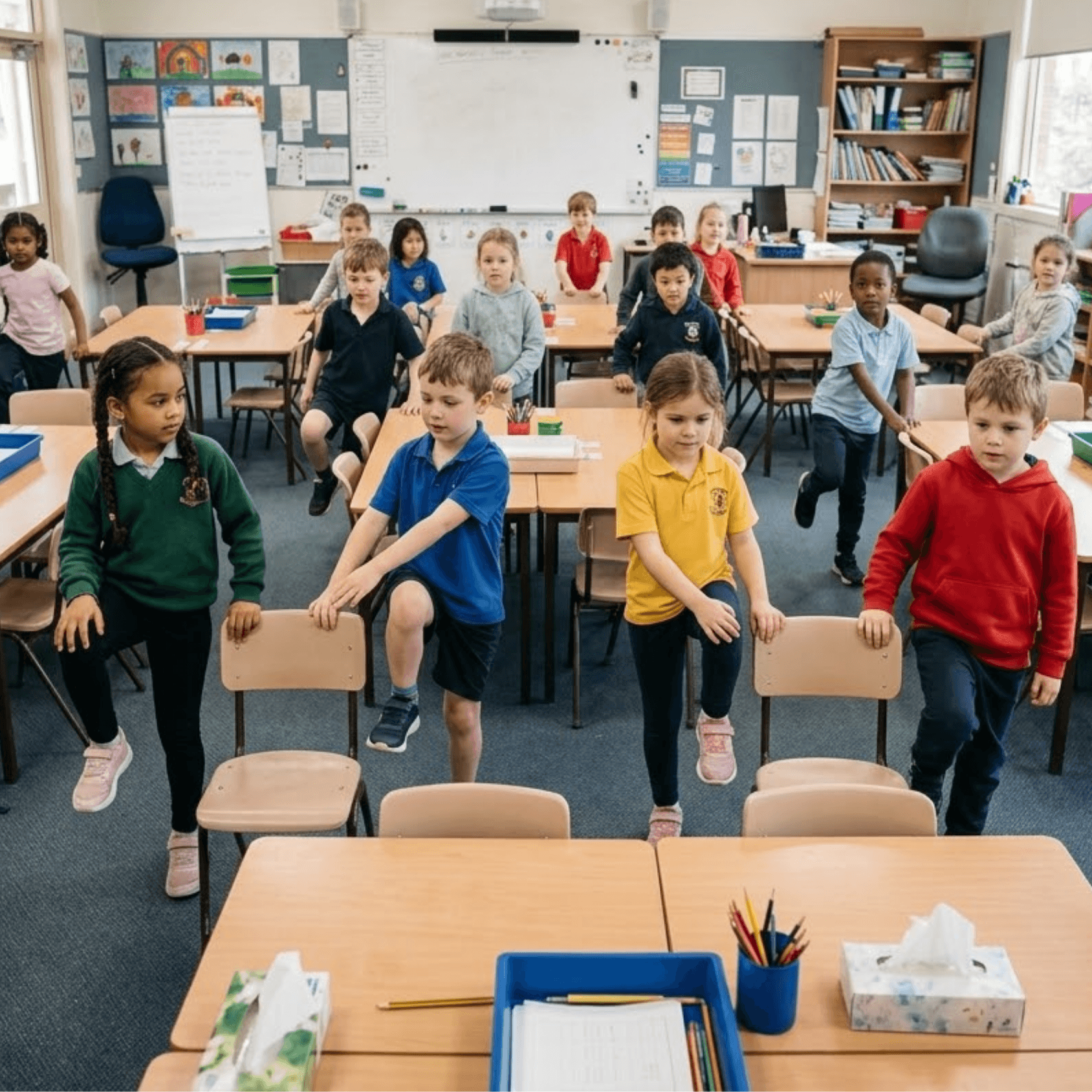
A cross crawl march combines alternating movement, single leg balance, trunk control and opposite side coordination.
Cross crawl power march
Have the children stand with enough room around them to march on the spot.
Lift the left knee and tap it with the right hand.
Put the foot back down.
Lift the right knee and tap it with the left hand.
Continue slowly from side to side.
I would start slowly because speed can hide what is happening. When children rush, momentum can help carry them through a movement they have not yet learned to control.
Make it easier before repeating it twenty times
If a child cannot organise opposite hand to knee while also balancing on one leg, we can reduce the difficulty.
That is not making the activity less valuable.
It is giving the child a version where they can actually practise the skill.
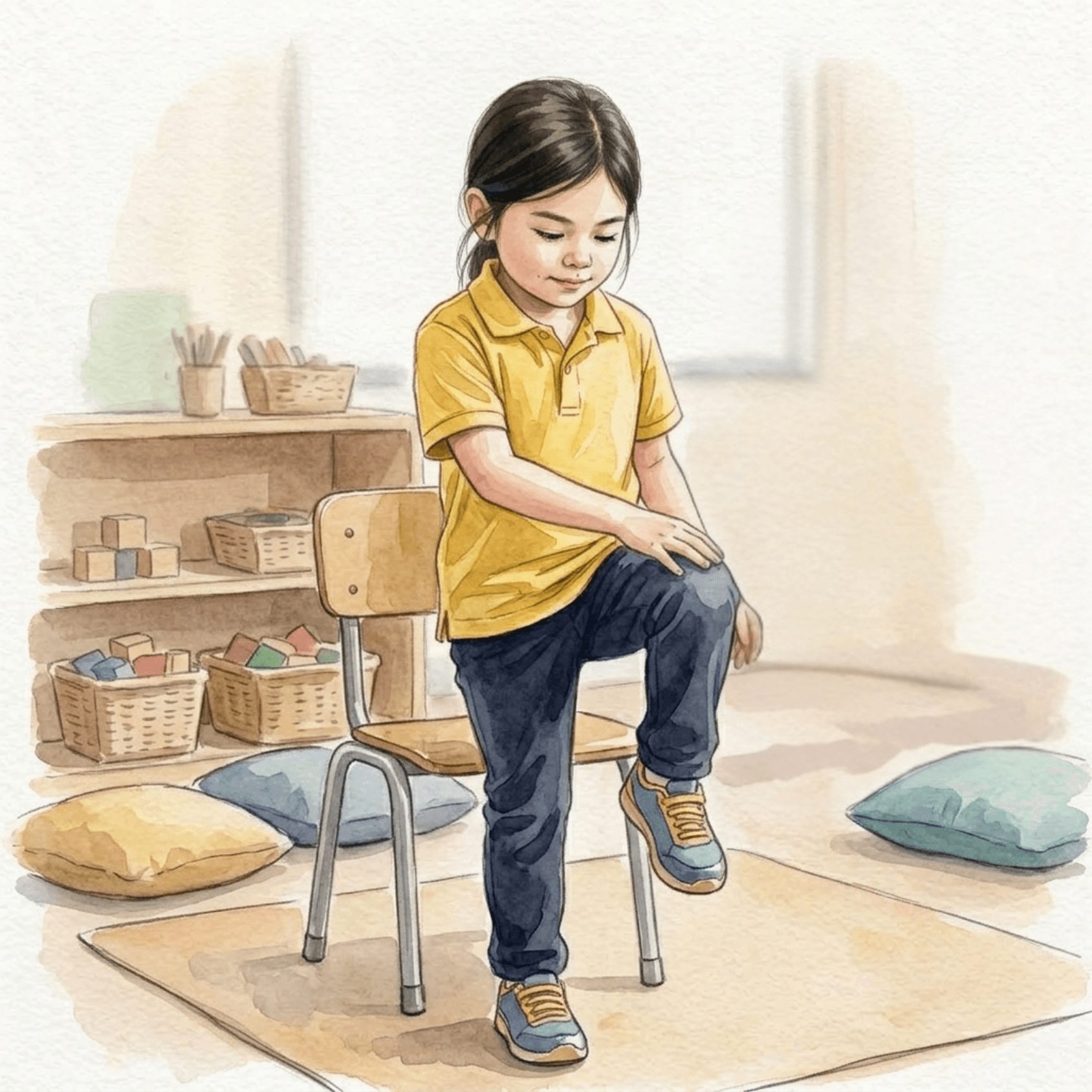
Holding a sturdy chair removes some of the balance demand so the child can concentrate on organising the opposite arm and leg.
Supported cross crawl
Let the child lightly hold a sturdy chair with one hand.
Start with knee lifts without the opposite hand movement.
Once that feels comfortable, add the opposite hand reaching toward the lifted knee.
Another easier option is to practise the pattern while seated so that balance is no longer part of the task.
You can then gradually bring the movement back into standing.
There is no prize for making it complicated
Teachers sometimes think a developmental movement activity needs lots of equipment or a complicated sequence.
It really does not.
Crossing movements can be built into the activities you already use.
Try:
- right hand to left shoulder
- left hand to right knee
- reaching across the table to collect a card
- placing objects on the opposite side of the body
- cross crawl marching
- crawling games
- large diagonal ribbon movements
- Simon Says with opposite side instructions
Watch what happens when you add a sequence
Once a child can perform a single cross body movement, you can add a little more motor planning.
Try:
Right hand to left knee.
Left hand to right knee.
Clap.
Repeat.
Now the child has to remember an order as well as organise the movement.
If the movement suddenly falls apart when a sequence is added, that is useful information too.
The original physical movement may be possible, but planning and remembering several actions together may be the harder part.
Do cross body exercises improve learning?
This is where I want us to be careful
You may have heard claims that crossing the midline switches on both sides of the brain, makes children smarter or directly improves reading.
I would not make those claims.
Bilateral coordination and crossing movements are genuine motor skills, and research shows that coordinated movement can be trained.
There is also research exploring relationships between sensorimotor skills and areas such as attention and school readiness.
But that does not mean one particular cross crawl exercise has a direct or guaranteed effect on a child's reading, concentration or academic achievement.
I use these movements because coordination, balance, trunk control, weight shifting and motor planning are valuable developmental skills in their own right.
What would make me look more closely?
One awkward cross crawl during a busy classroom game does not worry me.
I would become more interested if a child consistently has difficulty coordinating their body across many different situations.
I would pay more attention if the child also:
- finds running, skipping or jumping patterns difficult
- struggles to catch, throw or kick compared with peers
- has difficulty learning new movement sequences
- regularly bumps into objects or other children
- finds dressing or other two handed tasks difficult
- struggles with playground activities requiring coordination
- avoids movement because it seems difficult or frustrating
- has motor difficulties that are affecting everyday participation
Children with Developmental Coordination Disorder, for example, can experience difficulties across both gross and fine motor tasks, including balance, coordination, dressing and handwriting.
That does not mean an educator should diagnose DCD.
It means repeated motor difficulties across several parts of a child's day are worth documenting and discussing with the family.
What can educators do tomorrow?
Choose one simple cross body movement and watch what happens.
Do not correct every mistake.
Look at the strategy.
Does the child know which side to move?
Do they lose balance?
Do they rotate their whole body instead?
Do they need to copy someone?
Does slowing the activity help?
Does holding a chair make the movement suddenly much easier?
Evidence behind this article
These resources informed the clinical concepts in this article:
- Research on the development of bilateral reaching and coordination across childhood
- Research exploring bilateral coordinated movement and motor skill performance in children
- Research examining bilateral motor coordination, midline crossing and sensorimotor skills in preschool children
- Review of Developmental Coordination Disorder and everyday motor difficulties in children