Spatial awareness is one of those skills we often notice most when it is not quite working smoothly.
It might be the child who stands much too close to everyone in the line.
The child who bumps into the corner of the table that has been in the same place all year.
The child who struggles to copy a movement because they cannot quite work out which arm needs to go where.
Or the child who understands a letter one moment and then flips its orientation the next.
These things are not all caused by one problem, but they do remind us how much learning depends on understanding where things are in relation to ourselves and to each other.
What do we actually mean by spatial awareness?
Spatial awareness involves understanding position, direction, distance and the relationship between our body, other people and objects around us.
A child uses it when they reach accurately for a ball, walk around another person, fit themselves underneath playground equipment, follow a pathway, copy a body position or judge how far away something is.
Judging where the body is, where to move and how much space is available.
Position, patterns, shape, number lines, orientation and relationships between objects all use spatial thinking.
Children need to organise marks on a page and notice the orientation and position of shapes and letters.
Moving around furniture, lining up, finding belongings and following positional instructions all involve space.
Think about b, d, p and q
These letters are a lovely example of why orientation matters.
The visual components are very similar, but the position changes.
The line may be on one side or the other. The round part may sit above or below.
Young children commonly reverse letters while learning to read and write, so I do not want educators assuming that every reversal means a spatial awareness problem.
What I do want us to recognise is that position and direction are concepts children experience with their whole body long before we ask them to interpret those relationships in print.
Try nose to finger tapping
This is one of the simplest partner activities I use, and there is much more happening than it first appears.
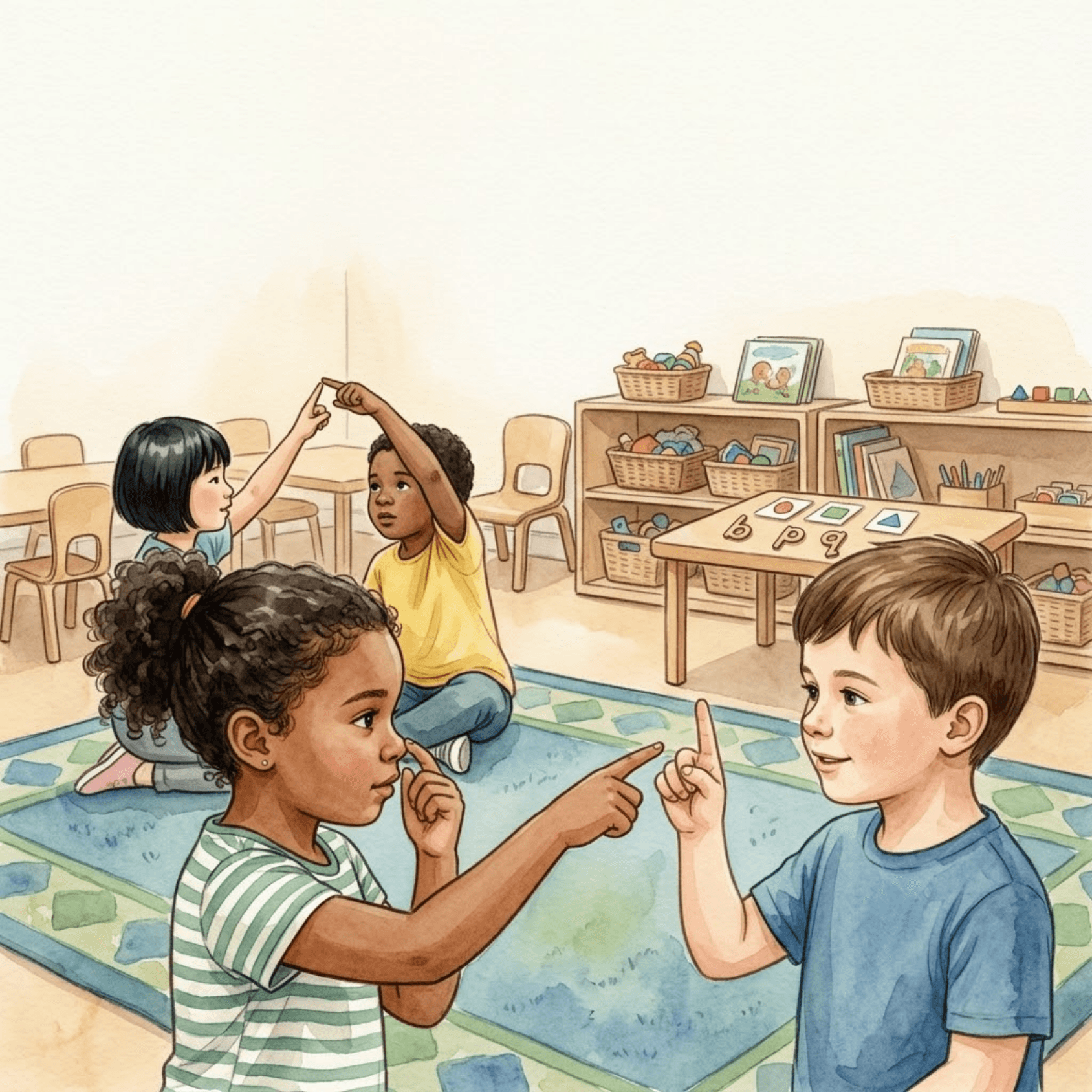
A partner gives the child a changing target in real space rather than another mark on a worksheet.
Nose to partner finger
Put children into pairs.
One child holds one finger out in front of their partner.
The other child touches their own nose, then reaches out and touches their partner's finger.
Repeat slowly at first.
Then start moving the target.
Higher. Lower. To one side. Across the middle of the body. A little further away.
The child now has to move from a known point on their own body to a changing point in external space.
Why I like this as an Exercise Physiologist
The eyes need to locate the target.
The child needs to work out where that target is in relation to their own body.
The shoulder and arm then need to organise a movement that reaches the correct place.
If the target moves across the body, the trunk may need to rotate and the arm may need to cross the midline.
Visual information, body awareness and motor planning are all coming together in one very simple game.
Simon Says is another spatial activity hiding in plain sight
Most teachers already know Simon Says, so there is no need for me to teach you how to play it.
What I want you to think about is how easily an old game can be changed when you understand what developmental skill you are trying to build.
Turn Simon Says into a spatial challenge
Simon says put your hands above your head.
Simon says put one hand behind your back.
Simon says take one step backwards.
Simon says stand beside your chair.
Simon says reach your left hand toward your right knee.
Simon says make your body lower than the desk.
Simon says stand between two chairs.
Now children are not only listening. They are physically experiencing positional language.
For younger children, model the movement and keep the instruction simple.
For children ready for more challenge, combine two spatial ideas in the same instruction.
Use real spaces too
Some of the best spatial learning happens when children have to move through an environment.
Walking between chairs.
Crawling underneath something.
Stepping over a line.
Moving around a table rather than through it.
Following a pathway made from masking tape.
Carrying an object from one side of the room to another without bumping into people or furniture.
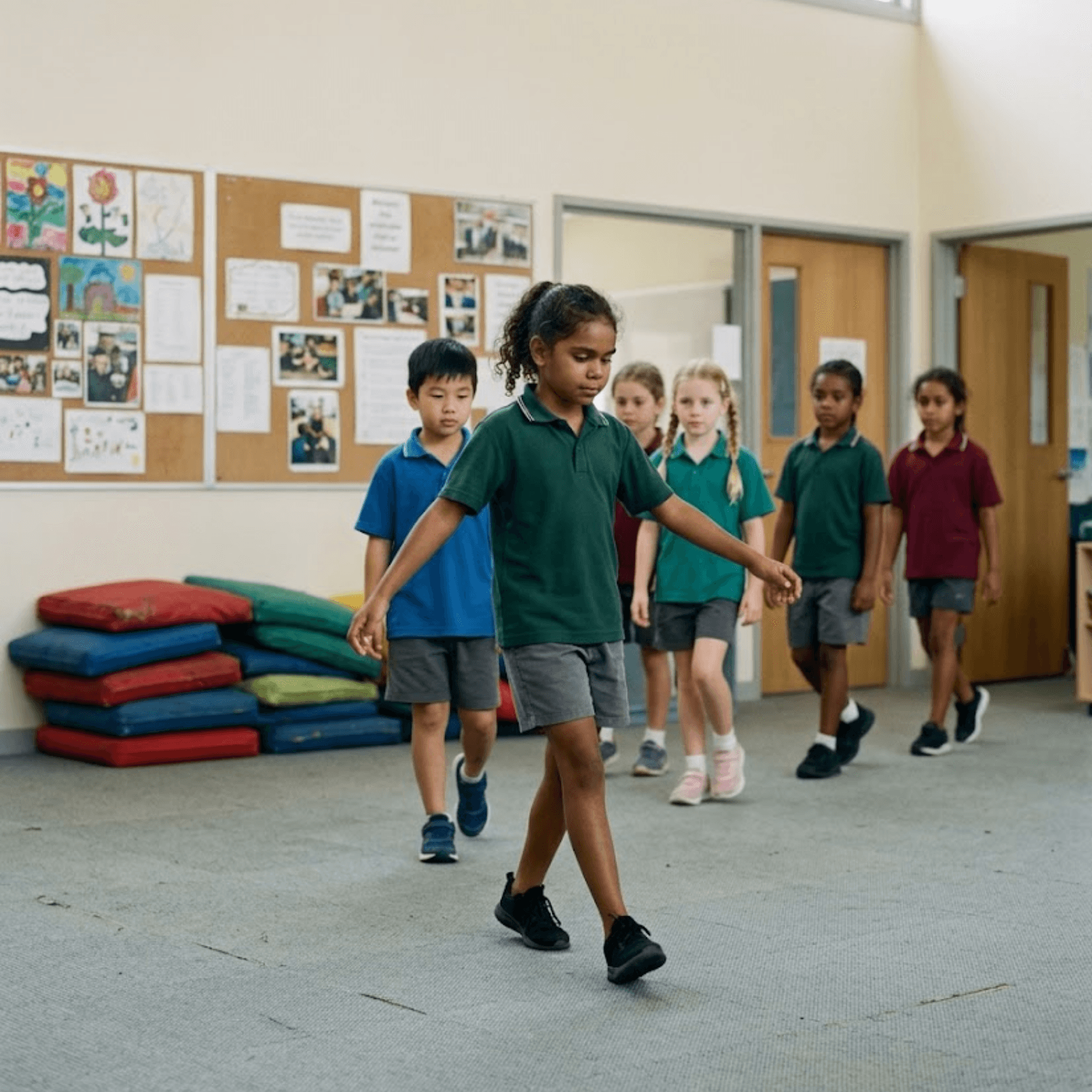
Real spaces give children changing information about distance, direction, obstacles and where their body will fit.
What might make me look a little more closely?
I would become curious if a child repeatedly:
- bumps into people, furniture or doorways
- struggles to judge how close they are to another child
- finds copying body positions unusually difficult
- has trouble following positional instructions
- struggles to navigate simple pathways
- seems unsure where to place their hands or feet
- finds cross body movements difficult
- has ongoing difficulty with visual spatial classroom tasks
None of these things on their own gives us a diagnosis.
But patterns across movement, learning and everyday participation are worth noticing.
You do not need another worksheet
If spatial awareness is something you want to build, I would not immediately reach for another page of arrows.
Let children experience the concept.
Put something above them.
Let them crawl underneath something.
Ask them to stand beside a partner.
Reach across their body.
Follow a pathway.
Move backwards.
Find the space between two objects.
Then bring those same words into maths, handwriting and classroom instructions.
Watch Robyn explain it
Want more spatial awareness activities?
In this video I talk through spatial awareness and practical ways to give children more experiences of position, direction and movement through space.
Watch the spatial awareness video on YouTubeWhat can you do tomorrow?
Start listening to the spatial language you already use.
Then make it physical.
Use words such as:
- above and below
- in front and behind
- next to and between
- near and far
- left and right
- across
- around
- through
- over and under
Ask children to show you those ideas with their body rather than only answering verbally.
That is when a simple classroom instruction becomes another movement opportunity.